
From Data to Decision: HPDA and HPC Reveal the Value of Cooling in Dairy Farming
Cypriot dairy farms are increasingly exposed to heat-related pressures that can affect milk production and overall farm performance. Assessing the potential impact of mitigation measures, such as cooling systems, is complex due to biological variability among cows and the influence of environmental and management factors. Conventional analytical approaches often face limitations in disentangling these effects, making it challenging to isolate specific drivers of productivity changes.
In this context, NCC Cyprus engaged in a collaborative study with Vettaky and the Kouloubris dairy farm to examine the effects of cooling system installation under real-world conditions. As part of this work, a Bayesian hierarchical modelling framework was developed, supported by High-Performance Computing (HPC) resources. The model integrates multi-year milk yield and weather data, while accounting for variability at the individual animal level, to investigate the relationship between heat stress and farm-level productivity.
The analysis explored the extent to which cooling interventions may influence milk yield under heat stress conditions. Results from the study indicate a measurable reduction in productivity losses, with estimates suggesting a decrease of approximately 0.31 tonnes per cow per year within the observed dataset. These findings provide an indication of the potential impact of such interventions under specific conditions, while also highlighting the role of advanced modelling approaches in supporting data interpretation.
This work demonstrates how HPC-enabled statistical methods can contribute to the study of complex biological production systems, supporting ongoing investigation into climate adaptation strategies in dairy contexts. The approach is being examined for its applicability across different settings, with the aim of informing further research into resilience and productivity under changing environmental conditions.
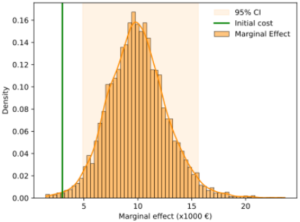
The figure depicts the posterior probability density of the marginal effect of the cooling system. The analyses showed that the installation cost is well below the 95th percentile indicating a clear positive outcome for the farm.